Khayal LabsResearch and product studioOman

Ideas, tested. Products, built.

Khayal Labs investigates promising ideas, tests them as working prototypes and engineers the ones that prove useful into dependable products.

On the bench Kawader Prototype Muhandis Concept

A question becoming a product Sketch stage: eight modules drawn as loose pencil squares around an open question.
Drawing KL-001
Title A question becoming a product
Stage
Scale Not to scale

Loose modules and an open question. Nothing is fixed yet.

  1. Every product starts as a question worth testing. It stays cyan until the evidence says it fits.
  2. Designed with the people who will use it every day, in Arabic and English.
  3. People stay in charge of the decisions. The software supports their judgement.
  4. Documentation, training and support, so the product keeps working after launch.
  5. Rules and models, tested against real cases before anyone relies on them.
  6. Collected with permission, cleaned and documented, so every result can be traced.
  7. Test results kept with the product, so every claim can be checked.
  8. Hosting, security and integration: the parts people rely on without seeing.

Sheet 02Selected work

Evidence from the bench

Each project is shown in its own identity and labelled with its real stage. A prototype is a working test with fictional data. A concept is a defined direction that hasn't been built yet. Open a project for the full details.

Project 01 · Built by Khayal Labs

Prototype · fictional data

A bilingual recruitment platform that turns a hiring request into an explained, evidence-based shortlist.

Employers describe a role in Arabic or English. Kawader ranks candidates on six weighted dimensions and shows the evidence behind every score. People make the hiring decisions.

Languages
Arabic and English
Match score
6 dimensions
Fictional profiles
1,000

Prototype. Built by Khayal with fictional data. It is not endorsed by, contracted with or connected to any ministry or government system.

Employer workspace Fictional data
Show step

Hiring requestArabic or English

نبحث عن محاسب مبتدئ للعمل في مسقط، بخبرة من سنة إلى ثلاث سنوات. إجادة Excel شرط أساسي، ويُفضَّل من لديه خبرة في قطاع التجزئة. الراتب حتى ٦٠٠ ريال عُماني شهريًا.

We need a junior accountant in Muscat with one to three years’ experience. Excel is essential, and retail experience is preferred. Salary up to OMR 600 a month.

RequirementsEditable before ranking

Ranked shortlistSix weighted dimensions

  1. 1 Maryam Al RawahiMuscat · 2 yrs · OMR 500 94 out of 100 Points lost: −6 Services experience
  2. 2 Aisha Al BalushiSohar · 1 yr · OMR 450 91 out of 100 Points lost: −5 Based in Sohar, open to Muscat−4 Available within a month
  3. 3 Salim Al HinaiMuscat · 3 yrs · OMR 475 82 out of 100 Points lost: −10 Availability not confirmed (unknown)−8 Excel declared, not yet verified

3 of 6 fictional profiles are eligible. The other 3 aren’t, and each one shows why. A recruiter makes the decision.


Fictional example Candidates are ranked on six weighted dimensions. Every score shows its evidence, and unknowns stay visible.

Project 02 · A Khayal Labs venture

Concept

Manufacturing intelligence, rooted in Oman.

Muhandis, Arabic for “engineer”, is a concept for one system: an instrumented production cell, qualified partner manufacturers, and AI that learns from every job. Engineers make the decisions.

Stage
Concept
Next step
Proof-of-concept cell
Base
Oman

Concept stage. No cell has been built yet, and there is no production system.

Concept drawing of an instrumented production cell Sketch stage: the parts of a production cell drawn as loose pencil sketches around a job specification.
DrawingMU-001
TitleInstrumented cell, concept
Stage
ScaleNot to scale

The cell as an idea on paper, with the parts it would need.

Concept illustration. It shows how a Muhandis cell would come together. Nothing in it has been built.

Sheet 03Inside the lab

Four rooms, one loop

Research, experimentation, engineering and delivery feed each other. Evidence moves forward. What we learn moves back.

Plan of the lab Four rooms arranged in a loop. Research hands a hypothesis to Experiment. Experiment hands evidence to Engineering. Engineering hands a tested build to Delivery. Experiment and Delivery both send what they learn back to Research.

Research

We study the problem, the people involved and the data that exists. The output is a sharp question and a hypothesis we can test.

Receives
A problem, field feedback, results from past experiments
Hands on
A hypothesis and a test plan
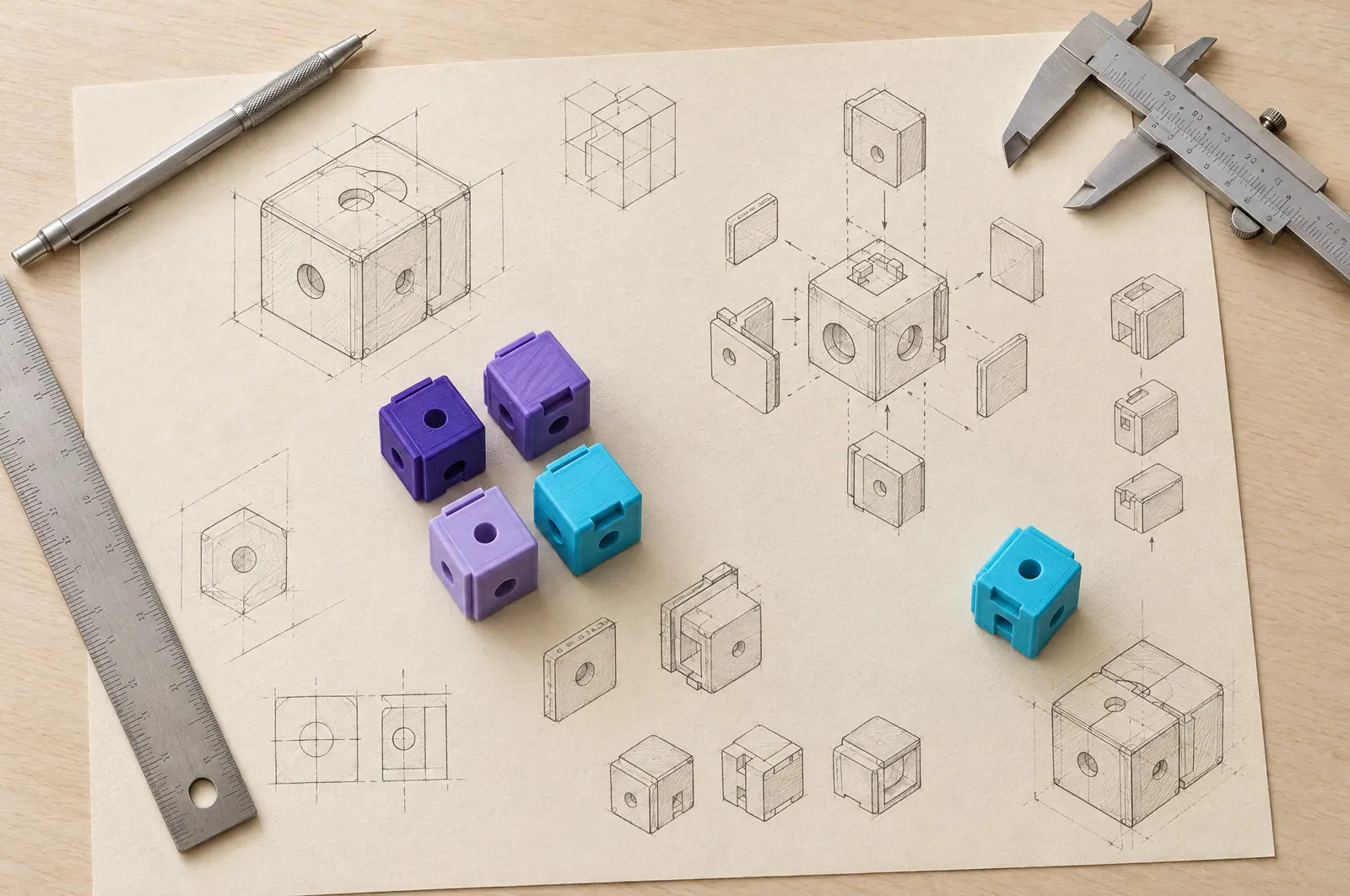
Pencil isometric studies of modular cube parts on drafting paper, with calipers, a ruler and printed cube modules in violet, lavender and cyan, one cyan module set apart.
Generated art-direction study (Higgsfield). It shows the visual language of the lab, not a photograph of a real space.

Sheet 04Experiments

Open questions on the bench

These are explorations. None of them is a product, and some may never become one. Each entry states the question and how far it has travelled.

  1. Question Framing the problem
  2. Concept An approach on paper
  3. Prototype Working, with test data
  4. Pilot Real use, limited scope
  5. Product In service
EXP-01Concept

Contracts you can question

Can a finance team ask plain questions of Arabic and English contracts and get answers that cite the exact clause?

Why it matters
Obligations, renewal dates and penalties sit inside long documents that few people have time to read.
What would count as evidence
Correct, cited answers on a test set of contract types, checked by a reviewer.
EXP-02Concept

Conversations into records

Can customer messages update a CRM accurately, with a person confirming anything uncertain?

Why it matters
Enquiries arrive in chat and are re-typed by hand, so details get lost between the message and the record.
What would count as evidence
Fewer manual edits, and no unconfirmed change ever reaches a record.
EXP-03Question

Accounts that explain themselves

Can monthly figures arrive with a plain-language explanation that a manager can check line by line?

Why it matters
Numbers without reasons slow decisions down and send questions back to the finance team.
What would count as evidence
Every sentence in an explanation traces back to the entries behind it.

Open slot

Have a question worth testing?

If a problem in your organisation could be answered with a small experiment, we would like to hear it.

Propose an experiment

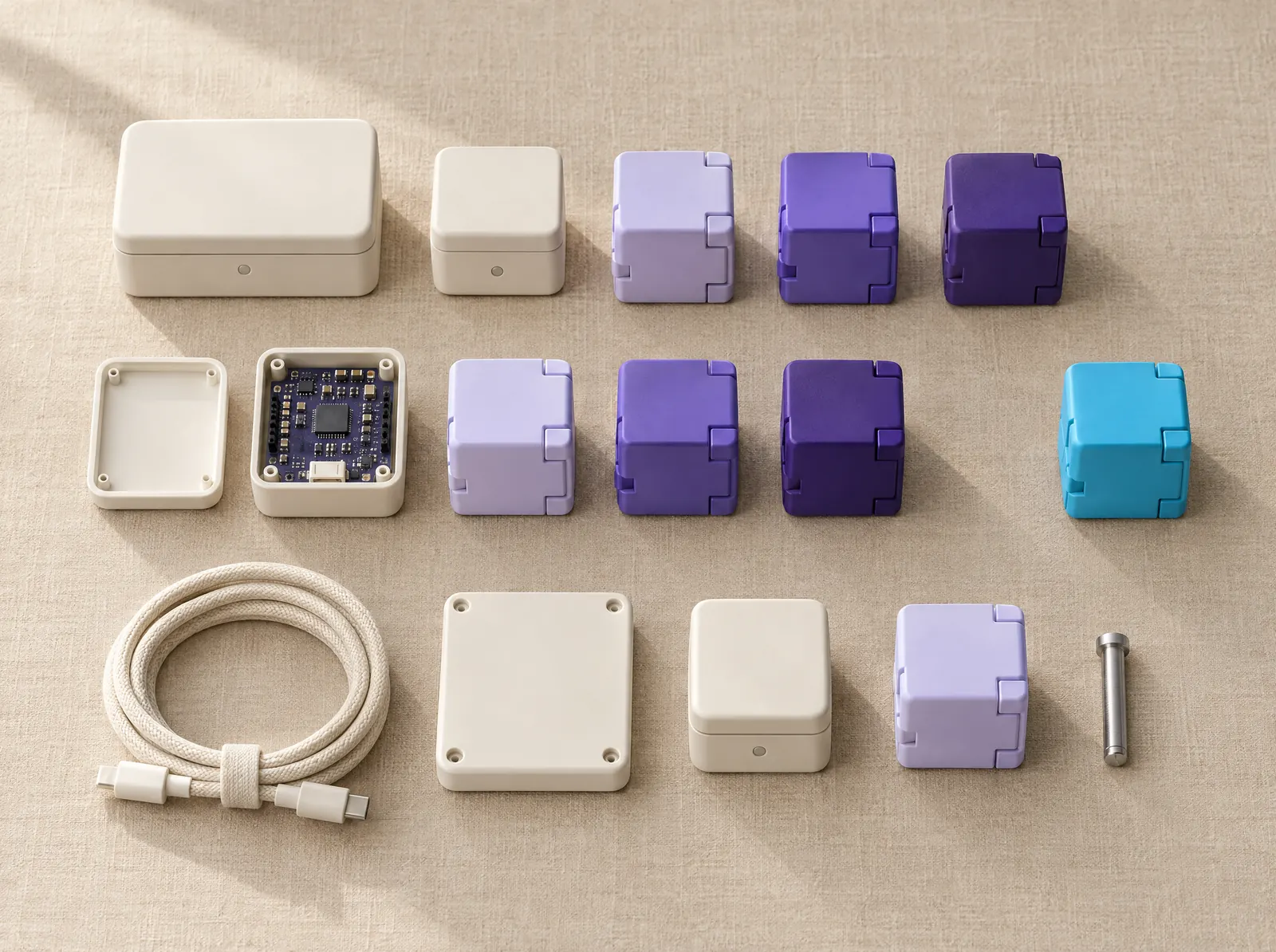
A grid of small modular prototype enclosures and cube modules in ivory, lavender and violet on linen, with one cyan module placed apart and one enclosure opened to show a circuit board.
Generated art-direction study (Higgsfield). Illustrative only.

Sheet 05How we build

From question to product, in five steps

Every step ends with a decision you can see. If the evidence says stop, we stop.

  1. Step 1: Understand

    We spend time with the people, the data and the constraints behind the problem, and agree what success would look like in numbers.

    You receiveA problem statement and success measures you can hold us to.

    DecisionIs this worth testing?

  2. Step 2: Experiment

    We test the riskiest assumption first with the smallest thing that can answer it: a sketch, a model or a clickable prototype.

    You receiveEvidence: what worked, what didn’t, and what it means.

    DecisionBuild, change course or stop?

  3. Step 3: Engineer

    We turn the proven approach into dependable software, including architecture, security, integration and an interface people can use.

    You receiveWorking software in regular increments you can review.

    DecisionDoes it meet the agreed measures?

  4. Step 4: Test

    We check it against real cases, edge cases and the people who will use it, including accessibility and content in Arabic and English.

    You receiveTest results and known limits, written down.

    DecisionIs it ready for real use?

  5. Step 5: Deliver

    We launch carefully, document what we built, train the team using it and measure the result against the original goal.

    You receiveA product in use, its documentation and a measured outcome.

    DecisionWhat should improve next?

Sheet 06About

خيال means imagination.

Khayal Labs is where that imagination is put to the test. We are the research and product studio of Khayal, based in Oman.

We work on problems where a better result can be measured. We test ideas cheaply before we commit to building them, and we label our work honestly, as you have seen on this page. The motto we work by is “From Khayal to reality”.

  • Augment people

    Software should make people better at their work. Decisions that matter stay with people.

  • Measurable over novel

    We choose problems where an improvement can be counted, checked and shown.

  • Test before building

    Small experiments decide what gets engineered and what gets set aside.

  • Say what's real

    Concepts, prototypes and products are always labelled as what they are.

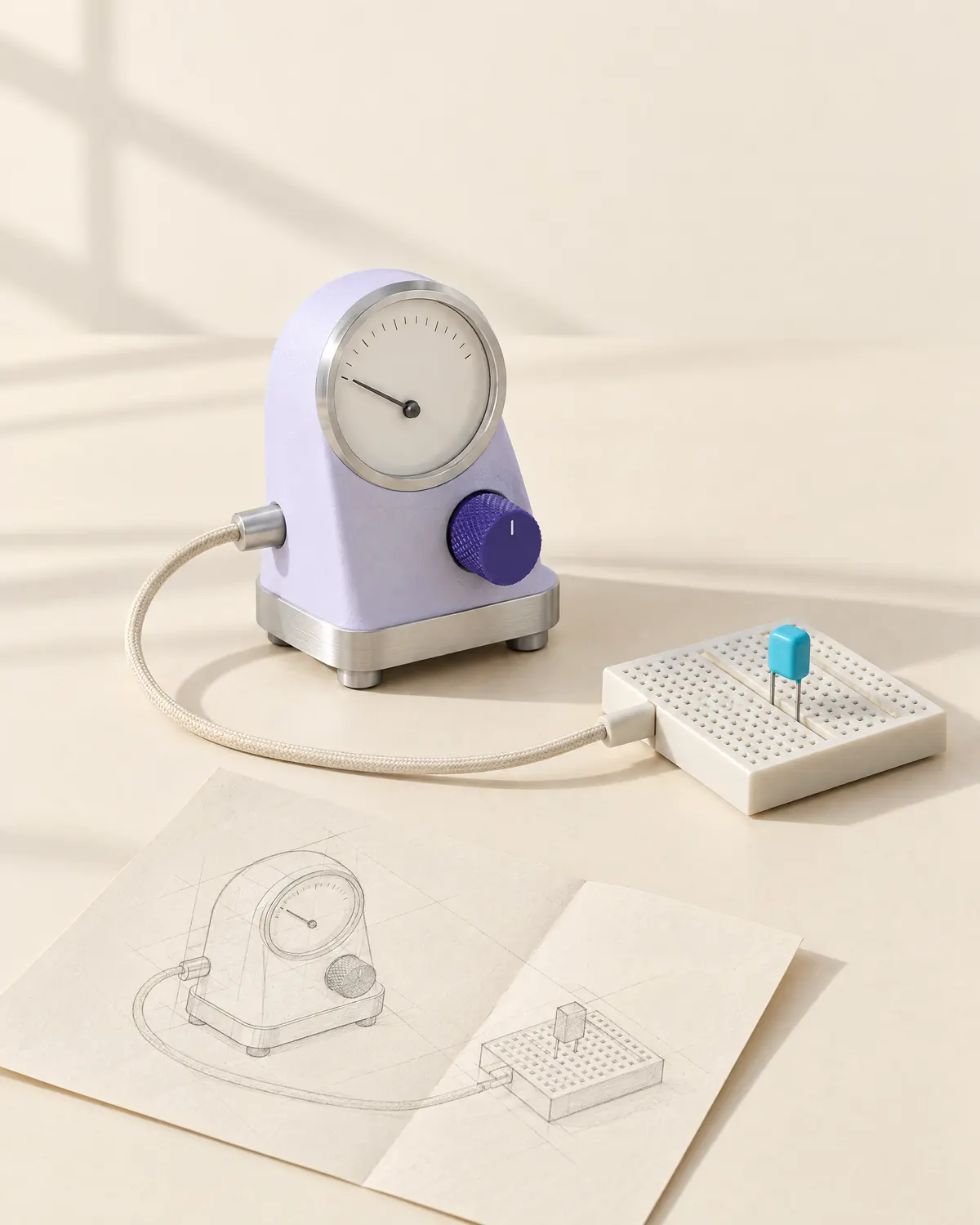
A small lavender measuring instrument with a needle gauge and a violet dial, cabled to a breadboard with one cyan component, beside a folded pencil sketch of the same device.
Generated art-direction study (Higgsfield). Illustrative only.

Sheet 07Contact

Bring us a question worth testing

Tell us what you are trying to improve and where it stands today. A clear problem is more useful to us than a finished specification.

  1. We read every enquiry and reply with questions or a suggested first step.
  2. If there is a fit, we start with a short discovery conversation.
  3. You receive a written problem statement before any build work is proposed.

Form preview. Online submission is not connected yet, so enquiries entered here are not sent.

What would you like to explore?

A few sentences is enough. Who is affected, and how would you know it worked?